
What is it like to be a full time karyakarta at Samskrita Bharati? How does one take a leap of faith into a life of seva and shiksha when all those around are pursuing more worldly goals? His storytelling skills are legendary and his classes are plain fun, however very few of us are aware of how Sri. Vasuvaj Easwaramangalam’s journey began.
Even while he primarily enjoys his retirement in Thrissur, gardening or attending the local temple utsavas, he still takes time to conduct his Sambhāṣaṇa shibirams. The last time he counted, he had crossed the 500 mark and eventually stopped keeping track!
I caught up with Vasuvaj Mahodaya who is visiting the United States to attend all the shibirams this year. While he talks casually of his early days, what I glimpsed is not just his humor and humility, but also the incredible people he has rubbed shoulders with. I can’t imagine what it must have felt like to be tutored by renowned vyākaraṇa vidhwans like Soti Nagaraja Sharma or Mahabhaleshwar Bhatt, or to share a class with Dr. Vishwas or Dr. S.R Leela!
His is a story that reminds us of the power of a life lived with purpose and simplicity.
What do you remember about the early days of Samskrita Bharati?
Samskrita Bharati was formally registered as an organization only in the early 1990s; however, its “pracāra kāryakramas” had begun nearly a decade earlier. At that time, the initiative was known as “Hindu Seva Prathisthānam, Samskrita Vibhāga”, a Karnataka-based organization.
It was founded in 1981 by Krishna Shastry, Janardhana Hegde, and Sadanand Dikshit, who had been classmates at Kendriya Vishwavidyalaya, the National Sanskrit University, with the goal of promoting Samskritam. Passionate about the language, they initially envisioned expanding its reach through the launch of a magazine.
Senior RSS leaders, including Sri Yadav Rao Joshi, Sri Krishnappa, Sri Ajith Kumar, and Sri H.V. Seshadri, appreciated their idea but posed a simple question: “Who would read the magazine?” People might buy it out of respect, they pointed out, but without the ability to read and understand Samskritam, they might never actually read it. They therefore offered a valuable piece of advice: first create readers, and then publish the magazine – “पठितारः भवन्तु, अनन्तरं पत्रिकायाः विमोचनं भवतु”.
These young men, then in their late twenties, began studying how languages such as German and French were taught and adapted those methodologies to suit the needs of contemporary Samskritam learners. They also explored innovative approaches with Padma Shri H. R. Nagendra, a physicist and engineer by training associated with Vivekananda Kendra, Kanyakumari, including the idea of teaching Samskritam through storytelling.
Through numerous discussions and experiments, the concept of an intensive “10-day Shibiram” gradually took shape. Between May and December 1981, Shastry Mahodaya alone conducted around 30 Shibirams. Janardhana Mahodaya similarly made Mangalore his kārya-kṣetra after moving there. Sadanand Dikshit eventually moved to Odisha, where he continued this work.
How did you learn of the organization?
In March 1982, the 33rd or 34th Shibiram was conducted for the first time outside Karnataka, at the RSS office in Chennai. I was introduced to the program by Sri. Shivaram Joglekar, himself a scholar. He had been invited as a senior prachārak of Tamil Nadu to observe the Hindu Sanghaman organized by the RSS in Karnataka, which was attended by more than 20,000 kāryakartās. It was there that he met Krishna Shastry, whose passion and dedication as a Samskrita prachārak had already become well known.
At the time, I was in my second year of the M.A. Sanskrit program at Presidency College in Chennai. Although I was studying Sanskrit at the postgraduate level, I was not yet fluent in conversational Sanskrit. Shastry Mahodaya was deputed to conduct a Sambhāṣaṇa Shibirams in Chennai, and I was asked to organise his classes.
We conducted two batches of classes, one in the morning and the other in the evening. The morning batch consisted of Bachelor’s and Master’s students like myself from Presidency, Queen Mary’s, and Vivekananda College. The evening Shibiram, which was advertised in the newspaper, attracted students from the general public.
I took the opportunity to attend both batches. After those ten days, I was amazed at how much I had learned. When I expressed my interest in learning more, Shastry Mahodaya invited me to Bengaluru.
You were already studying Samskritam—what drew you to Samskrita Bharati?
In college, I was taught Sanskrit texts such as Dhvanyaloka, Chitra Mimamsa, Rasa Gaghadhara, or Kalidasa’s Abhigyana Shakuntalam. We had wonderful teachers, but the curriculum was taught in English. I used to joke that it was not saṃskṛta pāṭhanam but Sanskrit Learning! Even the question paper and the required answers were in English. While we studied the language, we did not think that one could actually speak it!
As a grammar student I could write “ahaṃ gacchāmi” and “bālakāḥ gacchanti” but the words didn’t easily flow from my tongue. For the first time, this shibiram gave me the confidence to speak, and once convinced I was interested in bettering myself. The moment my MA examinations were done, even before my results arrived, I left for Bengaluru in June 1982.
Shastri Mahodaya and Janardhana Mahodaya came to the train station to receive me having obtained my letter. I remember Samskrita pracAra work was being done from an outhouse with asbestos sheets in Jayanagar! Initially, I was sent as an assistant to Janardhana Mahodaya as he conducted sAptahika melanams in different parts of the city.
Similarly motivated, three more people joined me—Vishwas, Ramachandra Adiga, and S. G. Nagendra. Together, we were trained in conducting Sambhāṣaṇa Shibirams and in becoming full-fledged pūrṇa kāryakartās.
By then, we had moved to the Rashtrotana building near Vidhana Soudha. Vyākaraṇa professors and scholars such as Soti Nagaraja Sharma, Manjunath Sharma, and Mahabhaleshwar Bhat would conduct classes for us. The only printed notes we used in our classes were a copy of the Samskrita Geetham “Mānasa Satatam”, along with a “saṅkhyā” and “kriyāpada koṣṭakam”.
At the end of the training period, each of us was assigned a different area of the city where we would begin our work.
Do you remember your first assignment?
Given my limited fluency in Kannada, I was assigned a predominantly Tamil-speaking area called Srirampura in Bengaluru .It was a slum with migrant laborers from Tamil Nadu who moved during Nehru’s prime-minister-ship. I used to conduct my classes in their leader Sarojamma, an AIDMK representative’s hut. It was a humbling experience – imagine my first shibiram was in a hut where about 5 or 6 people attended! It was my Tamil speaking skills that drew them and I was even accorded special respect because I came from Madras! Once my classes were done, we would invariably discuss the Tamil films of Sivaji Ganesan and MGR!
While I had initially planned to stay for just a few months, I ended up spending nearly a year there. In 1983, I returned to Chennai to enroll in an M.Phil. program. But even after returning, I found myself devoting more time to Samskrita Prachāram, conducting 10-day shibirams in different parts of Tamil Nadu, including Trichy, Gobichettipalayam, Rajapalayam, Coimbatore, Salem, Karaikudi and Madurai.
What was supposed to be a one-year course ultimately turned into a seven-year affair!
Could you share more about your experience of conducting the Shibirams?
Those were busy times. I would often conduct two Sambhāṣaṇa Shibirams concurrently, and sometimes even three or four! A typical three-shibiram schedule meant conducting separate sessions from 6–8 a.m., 12–2 p.m., and 6–8 p.m.
Eventually, I had to rein in my enthusiasm—not for lack of energy, but to save my voice!
For the Sambhāṣaṇa Shibirams, people came to my classes after seeing advertisements in newspapers or hearing about them on the radio, or after receiving handbills. I would also go door to door with volunteers, distributing handbills and inviting people to attend.
The praśikṣaṇa varga, or teacher-training program, was more challenging. Given the political climate in Tamil Nadu at the time, there were very few samskritam teachers. Eventually, word of mouth helped me reach people who had some basic knowledge of samskritam and were interested in learning more.
I never set a minimum qualification for students. I was happy to teach anyone who showed an interest. Just as a private bus driver in a small town might call out, “Kanchipuram, Kanchipuram, come aboard!” I would announce, “praśikṣaṇa varga – āgacchantu, āgacchantu!”, welcoming anyone who had even a basic understanding of samskritam! Today, the bar is much higher, with participants in India generally expected to have completed the Prabodhana Vargaḥ before qualifying for teacher training.
While many attended the training, only a few went on to conduct Shibirams in their hometowns. Nevertheless, many teachers shared that the training had significantly improved the quality of their teaching.
Can you recall some of the earlier praśikṣaṇa varga by Samskrita Bharati?
In November 1982, Samskrita Vibhaga, in collaboration with Sri Aurobindo Ashram in Pondicherry, conducted a “Praśikṣaṇa Varga” for Sanskrit teachers. One or two teachers from each state were invited to participate and were trained to conduct classes through the Samskritam medium. About 25 participants attended the program.
I remember Smt.S.R Leela, an author and Head of the Department at NMKRV College, who later went on to produce Sanskrit films in Bengaluru. T. S. Vijayan, a scholar and expert in the Kerala tradition of Āgama Śāstra, particularly the “Tantrasamuccaya”, was another notable participant.
The next praśikṣaṇa varga was conducted in Sringeri under the guidance of Chandrashekara Bharati and Bharati Thirtha Swamy where over 100 teachers came from different parts of India. One of the visitors to this shibiram was Nagaraj Patil who would later become foundational in establishing Samskrita Bharati in Fremont, United States. Swamini Atmaprakashananda of Arsha Vidya Gurukulam was also among the participants. At the time, she was known as Geetha from Coimbatore.
There a veethi natakam or street play called Jaguruko Bhava, was staged and performed by some students from IISc on the street outside the temple. They were short of one performer, and I was encouraged to join the troop! Growing up in the city I was never exposed to this ancient art until then so it was a novel experience!
From Sringeri, the next was in Mumukshu Bhavan in Kashi, and from there word spread faster about the organization and its efforts.
When did you finally come to the United States?
Even before I arrived, Krishna Shastri Mahodaya had come to California around 1995 and conducted several Shibirams. When I arrived in 1998, I made many new connections, to establish myself in the community. There were a group of software engineers in the Bay Area, such as Atul Narkhade, Prasanna Ganapati, Shivaram Bhatt, and Ramakrishna Kuppa, who helped me settle into life in the United States—even teaching me how to drive a car! My earlier association with the Hindu Swayamsevak Sangh (HSS) proved especially useful.
Through the HSS Camp, “Sangha Shiksha Vargah”, a 10-day camp in Sacramento, I also became involved in teaching. I taught “Niyuddha” (or Nishastra Yuddha), focusing on self-defense, physical fitness, and mental discipline. Within HSS, whenever a program involving Samskritam was needed, I readily offered to teach. I also conducted Shibirams and regular classes at the Sunnyvale temple on Siva sootrani etc.
There were several active volunteers in the area, including Vittal and Charu Bhave and Nagaraj Patil. Later, I shifted my base to Chicago, where I stayed in a house in West Chicago purchased by philanthropists Dr. Sukhdev Soni and Dr. Bharath Barai. Whenever invited, I taught the basics of Yoga and Samskritam in nearby communities and in other states, including Iowa, Florida, and Georgia.
What was the Alaknanda experience?
In July 2000, we decided to conduct the first “Praśikṣaṇa Varga” in North America. It was something of a gamble—we had pre-booked the facility based on the number of participants we hoped to attract, without knowing how many would actually attend. With the active support of volunteers including Govind Rao Yelagalawadi, Nagaraj Patil, Vikram Santurkar, Govinda Kurup of Rochester-NY, Radheshyam Dwivedi of MD, Shanta Viswanathan of Detroit and Dr.Jayasree from CT amongst others. The program was launched at the campsite. I had to rely on many people as I was not aware of how things worked here especially with logistics like insurance.
We began with basic conversational techniques, and as an icebreaker, each participant was asked to obtain the signature of Dr. Saraswati Mohan, who conducted classes at Chinmaya Mission San Jose-USA. Krishna Shastri, and Janardhan Hegde Mahodaya, were the instructors.
We soon encountered an interesting challenge. Participants of Indian origin often had a passive familiarity with Samskritam through exposure to their mother tongue and cultural environment. Those without that background, however, sometimes struggled even with proper nouns. They might not immediately recognize names such as Mahadeva or Govinda as masculine names, or Sita and Lata as feminine names. Since our goal was to teach entirely through the Samskritam medium, we recognized that this was an important challenge to address.
Around this time, we also decided to formally register the organization in the United States, with Vittal Bhave as President and Vikram Santurkar as Treasurer. A High Court attorney from Mumbai, who was pursuing a diploma at Stanford, wanted to attend the camp but could not afford the $750 fee. We encouraged her to attend regardless of her ability to pay. When we approached attorneys to help us with the registration and paperwork, the fees were prohibitively high. She therefore offered her services in a spirit of seva, preparing the necessary paperwork, including the bylaws for Samskrita Bharati USA.
We also realized that a nine-day program was too long for many participants. Given the geographical distances in North America, it might be more practical for people to travel to India to attend a longer Shibiram. We therefore compressed the program into a two-day format that could be conducted over weekends and long holidays, making it easier for people from different parts of North America to participate.
I returned to India in 2003, and after my twins were born in 2004, I was able to return only for shorter periods to conduct Shibirams. By then, the Samskritam community had begun to grow—not only in California, but also in the Boston area and beyond.
When did all the teaching material with books like Bhasha Pravesha, Abhyasa Pustakam or Darshini come into use?
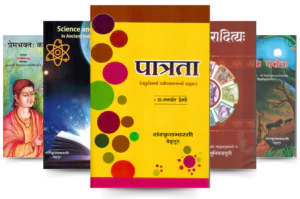
There were only a limited number of books available for use by the organization in those early days. I remember a small yellow book called “Vyavahāra Kośa”, one of the first such resources, which provided English and Kannada equivalents for each Samskritam word. Given our very limited funding at the time, the book was far from perfect – I remember that there could be as many as three errors on a page!
Over time, a better version, “Vyavahāra Sāhasrī”, came into existence, along with several other resources. Later, when Sri. Kutumba Shastry became Vice Chancellor of Rashtriya Sanskrit Sansthan, a set of five books was released, giving the teaching material a more formal structure.
The multi-level system of learning, such as L1 through L5, however, is distinctive to North America. In India, the traditional 10-day Shibiram format continues to be popular. The underlying teaching material is essentially the same, but in North America we have adapted these books as teaching aids, particularly at the higher levels.
What are your thoughts as you look back?
Around 2005 or 2006, I attended a Varṣika Melanam in Boston, where we discussed the idea of having an exclusive camp for teenagers. We launched Pragñā, and I was clear that I wanted young people to teach their peers. Adults, of course, guided them with the logistics and provided the necessary support. The program eventually became part of SAFL.
When I look at how the organization has grown, with so much work carried out by kāryakartās, I feel it is all Bhagavān’s grace. From one camp a year, we have grown to nine family camps across North America, along with “Camp Dhīmahiḥ”, exclusively for young adults under 30, and Saṃvāda Shibirams for more experienced learners. The scale of what has been accomplished is beyond my imagination.
Some participants have gone beyond the Shibirams to pursue an M.A. in Samskritam at Hindu University of America, while others have pursued postgraduate studies at Karnataka University. Through seva bhāvanā”, people are going above and beyond their daily jobs and responsibilities to contribute to the organization’s work.
Camp Dhīmahiḥ has been particularly encouraging—we have had to maintain a waitlist even after filling all 50 available slots. What has impressed me most is the enthusiasm of the youth: their willingness to learn and grow, even when they had little or no exposure to Samskritam in their early years.
I am very certain that there is a larger power driving this; without Bhagavan’s grace this amplification could not be possible.